Latest News
- 30. Jun. 2022
All syllabus information has been removed from this website and published on each country’s website.
Please refer to the web pages of each country for Grade examination syllabi.
Grade Examination Syllabi
What is YAMAHA Grade?
The Yamaha Grade Examination System was started in 1967 for the purpose of enabling everyone who is learning music to improve their musical skills in a well-planned manner while verifying their overall ability.
Yamaha Grade Examinations help teachers and music learners to confirm their musical abilities and encourage them to acquire all-around musical abilities so that they can enjoy creating and performing music.
Giving everyone learning music standards and motivation for achieving goals
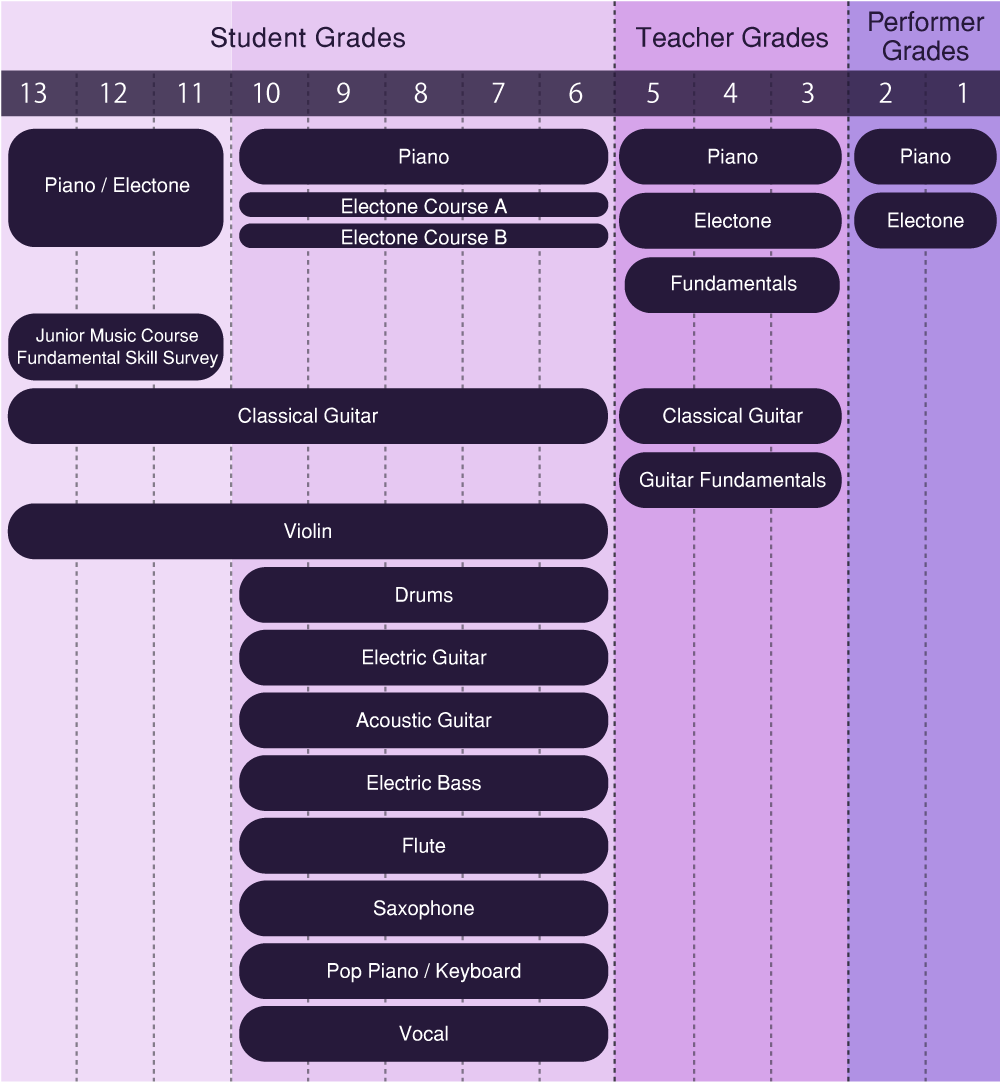
The Grade Examination System broadly targets two groups: students and teachers. Student grades are used as an objective assessment of the progress being made in learning music, while the teacher grades certify the performance ability as well as overall musical knowledge needed to provide music instruction.

The Yamaha Grade Examination System offers Performance Grades for Piano, Electone, Classical Guitar and Drums, and Fundamentals Grade.
They are classified into 2 categories:
Student Grades (10 - 6) and
Teacher Grades (5 - 3)
We also provide Student Grades for keyboard beginners (13 - 11) and Fundamental Skills Survey for Junior Music Course students. The system is designed to examine performance abilities and general music knowledge, both of which are necessary for enjoying music, teaching music fundamentals and playing professionally.
Expanding in more than 40 countries

More than 10 million people have taken these proficiency examinations over the past 40 years, and this system is widely accepted as the standard for assessing musical abilities.
The Yamaha Grade Examination System is also used in more than 40 countries/regions at present.
Yamaha Grade Examination Chart